

Red Flags When Screening Dental Candidates
By DDS Recruit Editorial ·
Summary: When screening dental candidates, red flags include vague resumes, unexplained short job stays, and inability to specify desired roles. Candidates who resist discussing work examples or have mismatched credentials should be scrutinized. During interviews, watch for inability to handle pediatric challenges, careless talk about parents, and lack of focus on operational tasks. Reference checks should confirm reliability and patient interaction skills.
A lot of hiring advice tells dental offices to move quickly when someone looks promising. Speed matters. That advice breaks down in pediatric practices when a candidate seems available before the office knows whether that person can stay calm around children, parents, short appointments, and a busy clinical team. A pediatric dental office should treat red flags as evidence to check, not as a cue to reject someone on instinct. The point is straightforward: screening should catch a mismatch with the role before the offer goes out, because a friendly resume does not prove chairside judgment, parent communication, or reliability under a packed schedule.
Red flags to watch for in a dental candidate are rarely dramatic in the first conversation. The useful warning signs are small gaps between what the candidate says and what the role will demand on a normal day, and the screening process has to make those gaps visible before the team starts rearranging schedules around a new hire.
Which dental candidate red flags show up before the interview?
A thin or vague dental resume is the first signal that the screening call needs to slow down. A pediatric practice should look for actual dental settings, role duties, software exposure, patient age range when that matters, and the kind of team structure the person worked in, because missing detail makes it harder to judge whether the candidate has done similar work. A work history with short stays and no explanation should not be read as proof of poor performance. A better reading is that the practice needs a direct question about why each move happened, what the candidate learned, and what kind of office the candidate is trying to avoid repeating, because a pattern only helps when the reason behind it is clear.
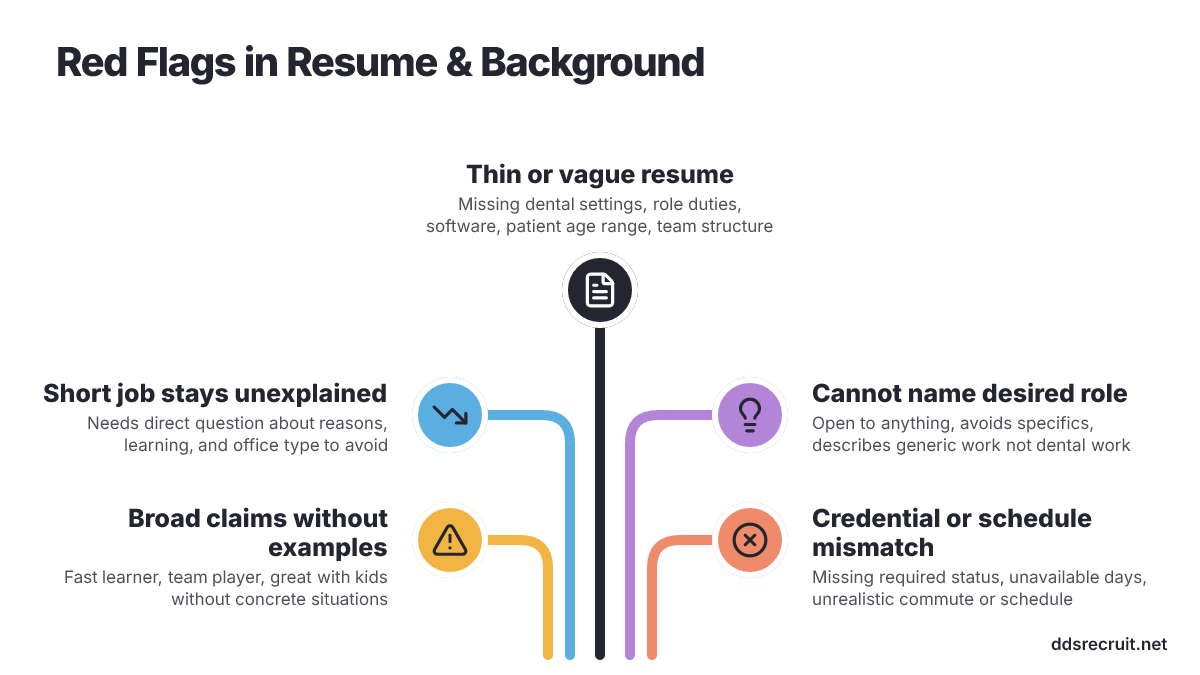
A candidate who cannot say what role they want is a risk for offices that need a specific gap filled quickly. A dental assistant who says they are open to anything, a hygienist who avoids talking about patient flow, or a front office candidate who only describes generic customer service may still be employable, but the practice has to test whether the person understands the dental job rather than the idea of a dental job.
A resume built on broad claims needs follow-up before the first interview slot is given away. Phrases such as fast learner, team player, and great with kids do not tell a hiring manager how the candidate acts when a child refuses to sit, a parent asks a billing question at checkout, or a dentist needs a clear handoff between rooms.
A credential or availability mismatch belongs in the first screen, not at the end of the interview. A practice hiring for a clinical role should confirm the required status for that role, the days the candidate can actually work, and whether the commute or schedule will hold once the candidate has seen the reality of the position. A candidate who resists ordinary screening questions can create a problem before the practice has enough facts. The concern is not privacy or caution from the candidate, but refusal to discuss work examples, references, schedule limits, or prior responsibilities in any concrete way, because pediatric teams need trust before they place someone near anxious children and time-sensitive treatment.
A new graduate applying for a tightly mentored role is the named exception to the strict resume screen. Limited work history is not the same as a warning sign when the practice has training capacity, clear supervision, and a role that does not require independent judgment from the first day.
Warning signs in dental candidate interviews for pediatric practices
The clearest red flag is a candidate who cannot say what they do when a child is scared, uncooperative, or overstimulated. A pediatric office does not need every applicant to recite a perfect script. It does need signs that the person can stay patient, follow the provider's lead, and avoid making a hard visit worse. A candidate who answers pediatric questions with only a love of children has missed the operational point. Liking kids is not the same as giving clear directions, spotting when a parent is making the appointment harder, keeping instruments in order, and helping the dentist or hygienist recover the schedule after a slow start.
A candidate who speaks carelessly about parents may struggle in a practice where parents are part of the appointment itself. Pediatric dental teams need staff who can explain next steps without sounding annoyed, because a parent who feels brushed off at check-in or checkout can turn a clinical win into a service problem. A candidate who blames every past conflict on former coworkers gives the interviewer no sign of self-correction. The warning sign is not that the candidate had a hard job, since many dental offices do. It is that the candidate cannot name any behavior they changed after a difficult team experience.
A candidate who treats sterilization, charting, or handoffs as background work is asking the practice to absorb a hidden risk. Dental roles rest on small repeated tasks, and a person who talks only about personality or production may miss the habits that keep a pediatric schedule from sliding into chaos. A front office candidate who cannot explain how they handle a frustrated parent needs more testing before the practice moves ahead. In a pediatric setting, the front desk often becomes the place where schedule pressure, insurance confusion, and parent anxiety meet, so the interview should include a concrete example rather than a pleasant chat about being good with people.
An associate dentist candidate who talks only about clinical autonomy may be a poor fit for a pediatric team that depends on steady communication. The concern is not ambition. It is whether the dentist can work inside the practice's behavior guidance style, treatment presentation approach, and team rhythm without dragging assistants and hygienists into conflicting expectations.
A hygienist candidate who avoids talking about patient education may not fit a pediatric office that depends on parent-facing prevention conversations. The role can call for calm repetition, age-appropriate language, and the ability to keep the visit moving while still making the parent feel heard.
A dental assistant candidate who cannot describe a good handoff should be asked to walk through a room turnover, a treatment setup, or a moment when the provider changed course. The answer will usually show whether the candidate sees the assistant's role as active support rather than simple task completion.
A strong interview should make warning signs in dental candidate interviews easier to spot without turning the meeting into an interrogation. The interviewer should ask for specific examples, listen for dental language, and compare each answer with the real pressures of the open role.
How should references and work history be read?
Reference checks ought to probe the same behaviors the interview already covered. In a pediatric practice, former supervisors or team leads should be asked about reliability, patient interaction, response to feedback, and how the person fits the pace of a dental office.
A pleasant interview can hide habits that only show up once the schedule gets full. A reference who offers only broad praise is less helpful than one who can talk through a normal workday. The stronger question is not whether the candidate was liked. It is how the candidate dealt with late arrivals, nervous children, parent questions, charting expectations, and changes in the schedule.
One glowing comment matters less than the pattern across references. If several contacts describe the same strength, such as calm chairside manner or steady attendance, the practice has something real to compare against interview gaps. Inconsistent or evasive answers should send the hiring manager back to the candidate with more questions. Work history gaps should be discussed plainly and respectfully. Dental hiring gets weaker when managers guess. A gap may reflect caregiving, relocation, school, burnout, or a previous office mismatch. The real question is whether the candidate is ready for the schedule and expectations now.
A repeated move across specialty or setting calls for a role-fit conversation. A candidate leaving general dentistry, orthodontics, or another environment for pediatric dentistry may bring useful skills. The practice should ask what will be different before assuming enthusiasm alone will carry the transition. A candidate who refuses references without a reasonable explanation leaves the practice with little to verify. A current employer may be sensitive, but a former supervisor, dentist, lead assistant, hygiene lead, or office manager can usually speak to work habits if the candidate has real dental experience.
Reference questions should stay the same from one candidate to the next for the same role. That makes comparison cleaner, and it keeps the final hiring decision centered on the work rather than on whichever applicant gave the most polished interview.
When is a fast hire still the wrong hire?
A rushed hire is wrong when a practice tries to fix a coverage hole and ignores a fit problem. Pediatric dental offices feel the pressure as soon as a chair, hygiene column, or front desk shift opens up, but a candidate who cannot handle the patient group or the team pace just moves the shortage from the schedule into daily work. A temporary gap can do less damage than a lasting mismatch. A practice may be better off with a manual search, a call through its network, or a wait for a stronger candidate when the open role calls for close contact with children, parent communication, and independent judgment that the current applicant has not shown.
A cheaper screening route makes sense when the practice already has a known candidate pool and a manager with time to check people carefully. Job boards and direct referrals can work for offices that have clear interview questions, quick follow-up, and enough dental knowledge on the hiring side to separate confidence from competence. A generalist recruiter or job board gets weaker when the screening criteria are dental-specific. Pediatric practices are not just hiring for availability. They are hiring for dental language, chairside rhythm, parent communication, infection-control habits, and tolerance for the unpredictable behavior of children.
DDS Recruit handles dental team recruitment, associate dentist placement, and dental hygienist and assistant staffing for practices that need dental hiring support. The firm describes itself as dental-industry-specific recruiting for practices that want candidates screened through a dental lens rather than a generic job-board filter.
A long-standing staffing relationship can become a screening advantage because the recruiter learns what the practice actually means by fit. A supplied client comment says, Always has weekly assignments, 2-3 days a week consistently for the past 5 years. Gayle is an advocate. Great relationships. That kind of continuity matters when the office is trying to avoid repeating the same hiring mistake.
A fast candidate should still be slowed down when the answers do not match the job. If the open role touches children, parents, and a tightly timed clinical team, the practice needs evidence of fit before speed turns into a weak offer.
A screening process that catches the problem before the offer
A practical screen begins with the hardest parts of the job. A pediatric office should write down the moments that create the most strain, like frightened children, parent objections, late arrivals, rushed turnovers, or schedule changes, then shape interview questions around those situations. A resume review should separate missing details from negative ones. Missing information calls for a question. Contradictions between the resume, the screening call, and the interview call call for a pause, because the practice cannot make a steady hire from a story that keeps shifting.
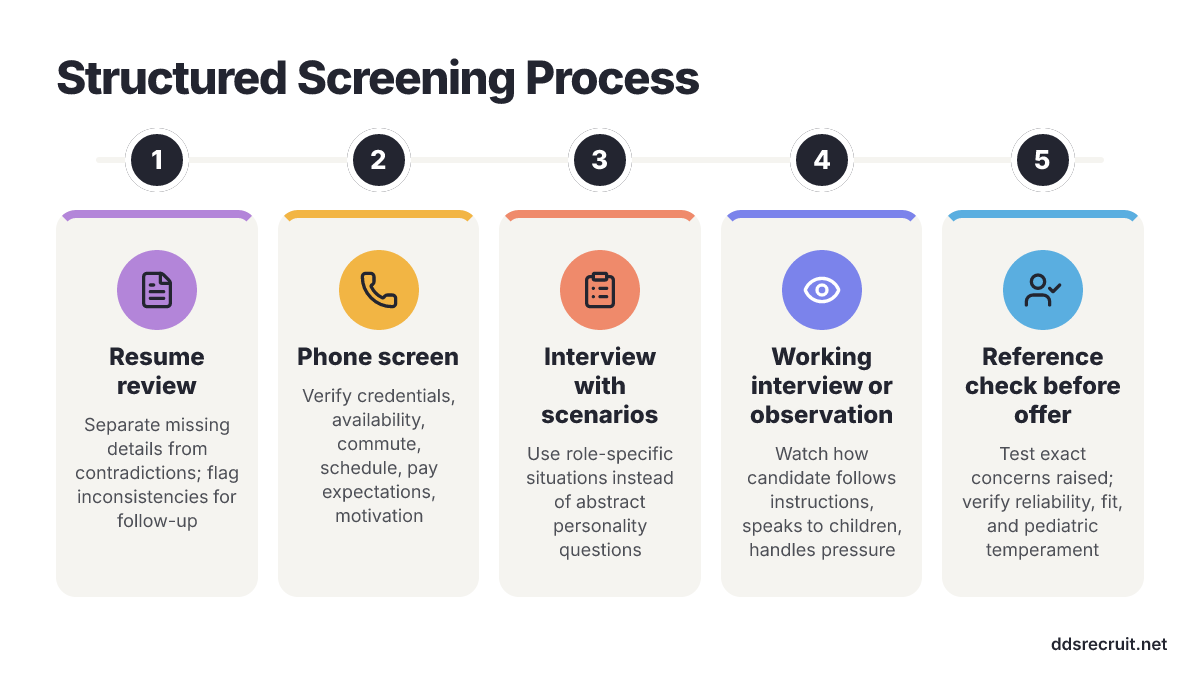
A phone screen should cover the basics before the team spends clinical time. The hiring manager should ask about required credentials for the role, real availability, commute tolerance, the desired schedule, pay expectations if the practice brings them up early, and the candidate's reason for considering pediatric dentistry.
An interview should use role-specific scenarios instead of abstract personality questions. A dental assistant can be asked to walk through room setup and provider handoff, a hygienist can explain how they talk through home care with a parent, and a front office candidate can describe how they would respond to an upset caregiver at checkout.
A working interview or skills conversation should be built around observation, not improvisation. The practice should decide ahead of time what it is watching for, such as how the candidate follows instructions, speaks to children, asks for clarification, and reacts when schedule pressure becomes visible. A reference check should happen before the offer feels emotionally final. Hiring managers sometimes call references after they have already made up their minds, but references work better when they test the exact concerns raised during the interview and give the candidate a fair chance to address any mismatch.
A final review should name the risk in plain language. The team should be able to say whether the concern is reliability, pediatric temperament, clinical skill, parent communication, team fit, or unclear motivation, because vague discomfort leads to uneven decisions. A documented process protects the practice from hiring under pressure. Practices that want an outside partner to explain the recruiting steps before the search begins can review how the hiring process works and decide where outside screening would save the internal team the most time.
A screening process should end with a decision the practice can defend. If the candidate has the skills but not the pediatric temperament, the answer differs from a candidate who has the temperament but needs training, and the offer should reflect that difference.
Conclusion
Start by rewriting the interview around the hardest part of the open role, not around the nicest version of the candidate. A pediatric dental practice needs questions that show how a person behaves with children, parents, handoffs, schedule pressure, and feedback.
The first step is to audit the last hire that did not work and name the warning sign that showed up earliest. If the pattern points to weak screening rather than a weak candidate pool, build a tighter screen before posting again or bring in dental-specific help through a staffing consult request. The advice stops at the hiring decision, because after the offer, retention depends on training, leadership, and whether the practice delivers the role it described.
Frequently Asked Questions
What are the red flags in a dental candidate's resume?
Red flags in a dental candidate's resume include vague descriptions, unexplained short job stays, and broad claims without specific examples. These signs suggest the need for further questioning to understand the candidate's actual experience and fit for the role.
Why is it important to ask dental candidates about their desired role?
Asking candidates about their desired role helps determine if they understand the specific demands of the position. A candidate who cannot specify their role preference may not be prepared for the job's requirements, which is crucial for filling a specific gap quickly in a dental practice.
What should be discussed during a dental candidate interview for a pediatric practice?
During an interview for a pediatric practice, candidates should discuss how they handle pediatric challenges, manage interactions with parents, and perform operational tasks. It's important to assess their ability to stay patient, follow the provider's lead, and maintain a smooth workflow.
How can reference checks help in screening dental candidates?
Reference checks should confirm the candidate's reliability, patient interaction skills, and response to feedback. They provide insights into how the candidate handles late arrivals, nervous children, and schedule changes, offering a real comparison against any gaps noticed during the interview.
What should be considered when a dental candidate has a work history gap?
Work history gaps should be discussed openly, as they may reflect personal reasons like caregiving or relocation. The key is to determine if the candidate is currently ready for the role's schedule and expectations, rather than making assumptions about their past.