

Alternatives to Job Boards for Dental Hiring
By DDS Recruit Editorial ·
Summary: For dental hiring, especially in child-focused practices, alternatives to job boards include using dental-specific recruiters for qualified candidates, leveraging referral pipelines from current staff, employing temp or fill-in staffing for immediate needs, and conducting direct outreach to passive candidates. These methods target the right candidates more effectively than job boards, which often yield unqualified applicants.
A hygienist calls out before a full preventive schedule, and the front desk starts shifting families before the first child sits down. A parent who booked around school hours is offered a later slot, the assistant gets pulled from another column, and the doctor loses the pace that keeps a child-focused practice calm.
A job board post may go live by lunch. The practice still needs someone who wants pediatric dentistry, accepts the schedule, fits the team, and has the credentials to work without adding more supervision. For child-focused dental practices, job boards belong at the edge of the hiring plan, not at the center, because the hardest roles get filled through targeted channels before a passive candidate ever applies.
The practical question is which hiring channel reaches the right dental people faster, screens for the realities of treating kids, and leaves the office manager with fewer unqualified conversations to handle next. It is not about whether a job board has any value.
Why a dental job board stops short for hard-to-fill dental roles
Dental job boards are built for openings people can see, while the hardest pediatric dental hires are usually already employed, casually open to a move, or only interested if the practice matches their preferred schedule and clinical rhythm. LinkedIn Talent Solutions' 2014 global survey of 18,000 professionals in 26 countries found that fully employed workers were passive candidates, which explains why a public post reaches only part of the available market. Dental hiring also breaks down when a post treats every applicant as the same. A registered dental hygienist who works well with anxious children, a dental assistant who can keep a treatment room moving, and a front office hire who can handle parent concerns all solve different staffing problems, even when the job board form makes every opening look like a title, a wage range, and a shift.
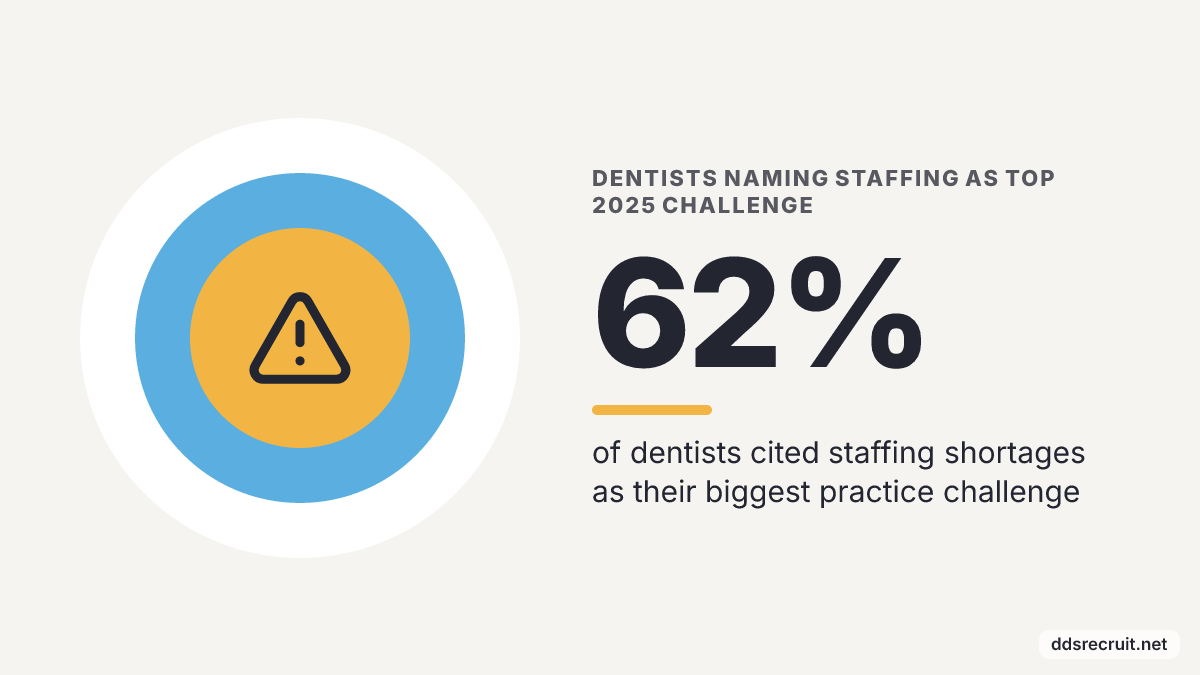
The American Dental Association's Health Policy Institute reported in ADA News in 2025 that staffing shortages were the top response when dentists were asked in late 2024 about the biggest challenge facing their practices in 2025, with about 62% choosing that answer. A practice that treats children feels that shortage differently because missed coverage affects schedule control, parent trust, and the ability to keep the clinical team calm through behavior management. Jennifer Thompson, vice chair of the ADA Council on Dental Practice, described the hiring bind in ADA News in 2025 when she said dentists face a limited pool: "Offices are faced with either not having any applicants or hiring someone from a limited pool who may not necessarily align with your practice philosophy, workplace culture, schedule preference or desired pay and benefits." That sentence is a useful test for every job board applicant, because a resume only starts the conversation.
A board post still makes sense when the practice has a flexible start date, a broad applicant pool, and a role where dental-specific screening is less demanding. A pediatric office filling a specialized clinical role, replacing a high-performing hygienist, or covering several chairs across locations needs a channel that screens before the manager spends time interviewing.
What should replace a job board in a pediatric dental hiring plan?
The best replacement is not a single channel, but a smaller hiring system that separates urgent coverage from permanent placement. A child-focused practice should decide whether the immediate risk is an open shift, a long-term vacancy, or a repeated mismatch after hire, because each problem points to a different alternative.
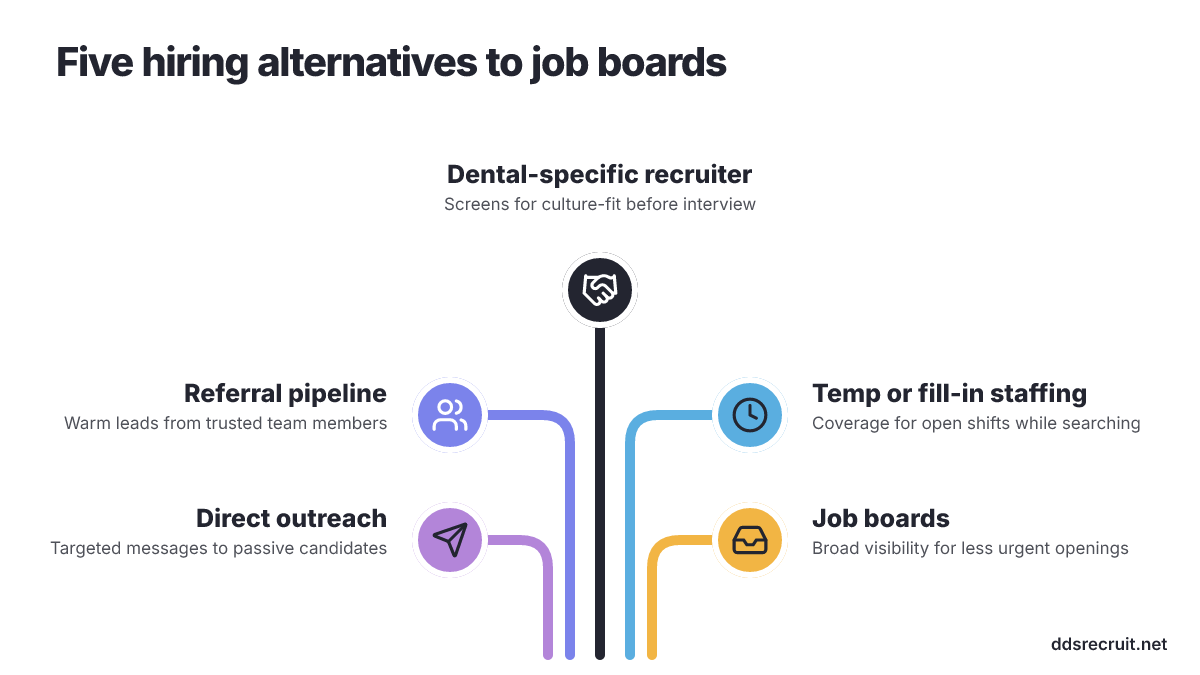
A dental-specific recruiter is the strongest fit when the practice needs qualified candidates who already understand dental office workflows and can be screened for culture-fit before an interview. A generalist recruiter may understand hiring mechanics, but a dental recruiter is more likely to know the difference between a candidate who likes children and a candidate who can work productively in a pediatric operatory.
A referral pipeline works best when the practice already has respected clinicians who know peers with similar standards. The office manager should ask current hygienists, assistants, and front office leads for names tied to a role, not for a generic share of an opening, because a direct name creates a warmer conversation than a social post.
A temp or fill-in channel is the practical answer when tomorrow's schedule is the risk. Temporary support will not replace a permanent hiring plan, but a reliable fill-in hygienist or assistant protects production and patient experience while the practice continues a more deliberate search.
Direct outreach is useful when a practice can describe a role in a way that matters to a specific candidate. A message that names pediatric experience, schedule expectations, team structure, and growth path earns more attention than a public posting copied into an inbox.
Dental hiring alternatives compared
| Hiring channel | Best use | Main trade-off | What to check before relying on it |
|---|---|---|---|
| Dental-specific recruiter | Associate dentist placement, hygienist searches, assistant staffing, and culture-fit screening | The practice pays for outside recruiting work | Ask how dental candidates are screened before interviews |
| Referral pipeline | Warm leads from trusted dental team members | The network may repeat the same candidate profile | Ask referrers to name the role, schedule, and pediatric fit they are recommending |
| Temp or fill-in staffing | Coverage for open hygiene or assistant shifts | Short-term coverage does not solve repeated turnover | Track whether the same coverage gaps keep returning |
| Direct outreach | Passive candidates who will not apply cold | Outreach takes time and needs a clear message | Write the role around schedule, clinical setting, and child-focused expectations |
| Job boards | Broad visibility for less urgent openings | Applicant quality is uneven and screening falls on the practice | Keep the post active only when someone can respond quickly |
DDS Recruit is a dental-industry-specific recruiting firm that helps dental practice owners, DSOs, and office managers quickly fill open roles with qualified, culture-fit candidates. DDS Recruit's work includes dental team recruitment, associate dentist placement, and dental hygienist and assistant staffing, which is the kind of focused support a pediatric office needs when a job board has produced resumes but not viable hires.
The practical order is simple: use temporary coverage to protect the schedule, referrals to surface warm leads, direct outreach for passive candidates, and a dental-specific recruiter when the practice cannot afford to spend another hiring cycle sorting weak matches. A job board can stay open in the background, but it should not be the only route to a child-ready dental hire.
How should a practice build a referral pipeline that actually produces candidates?
A referral pipeline starts with a named role, not a plea for help. A pediatric practice that asks, Do you know a hygienist who is comfortable with children, prefers a family schedule, and can step into a busy recall column? Will pull in better names than one asking staff to pass along a vague opening.
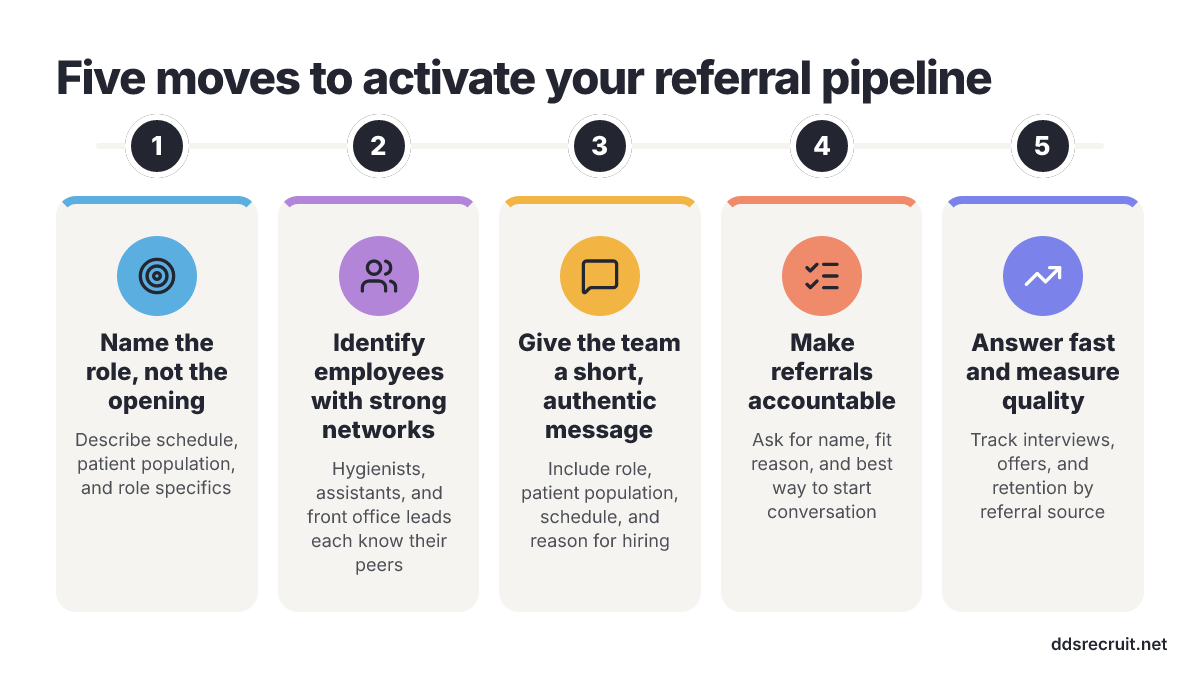
The first move is to decide which employees have the strongest outside networks. Hygienists know hygienists, assistants know assistants, and front office leads know people who can handle insurance conversations and parent questions without sending every issue back to the doctor.
The second move is to give the team a short message that sounds like the practice, not a corporate job ad. It should name the role, the patient population, the schedule reality, and the reason the team is hiring, because serious dental candidates want to know what problem they are stepping into. The third move is to make referrals accountable without making them awkward. The office manager can ask for a name, a brief reason the person fits pediatric dentistry, and the best way to begin a respectful conversation, rather than asking an employee to sell the job to a friend.
The fourth move is to answer fast when a referral comes in. A referred candidate who hears nothing for several days learns that the practice's hiring process is disorganized, and pediatric practices cannot ask candidates to trust that the clinical schedule is well run when the first hiring contact drags. The fifth move is to measure what referral quality looks like. A practice should track which referrals reach interviews, which referrals accept offers, and which referrals stay through the early adjustment period, because a pipeline built only on volume recreates the same weakness as a job board.
Referral hiring has a cost that practice owners sometimes miss. A team can get too familiar if every hire comes from the same circle, so pediatric offices should use referrals for trust while still screening for values, pace, parent communication, and comfort with children who need extra time.
When does a dental-specific recruiter make more sense than another posting?
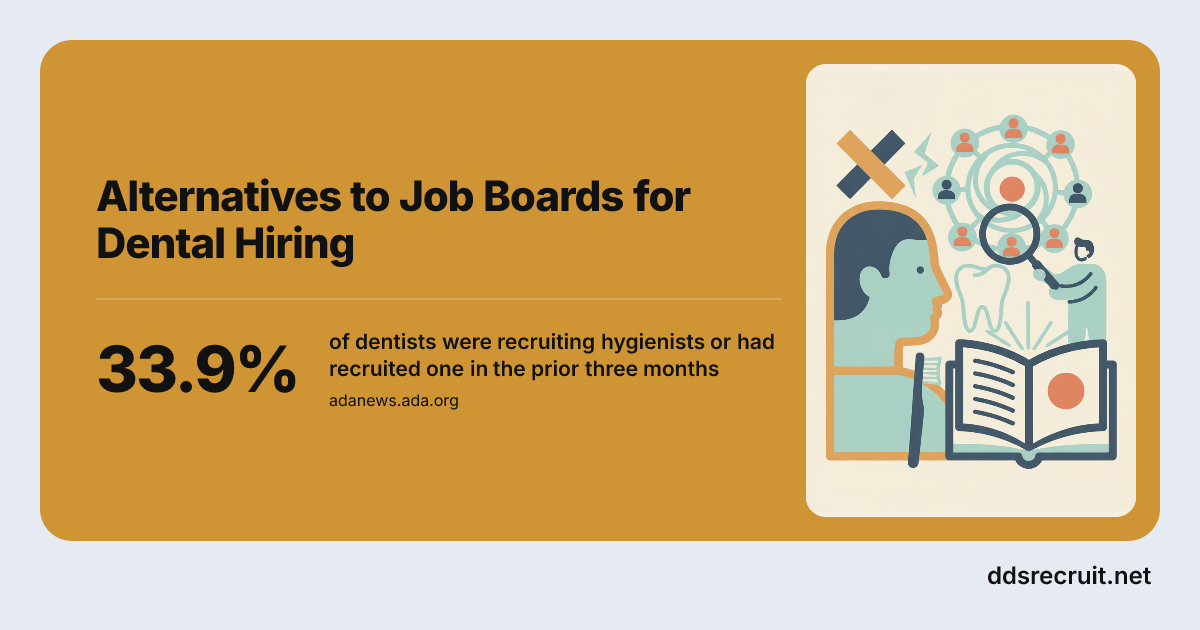
A recruiter makes sense when the practice already knows the job board is not the problem, the candidate market is. ADA News reported in 2024 that in Q3 2024, 33.9% of dentists were recruiting hygienists or had recruited one in the prior three months, and among those dentists, 91.7% said recruitment was very challenging or extremely challenging. A pediatric practice should bring in a dental recruiter before the opening turns into a repeating schedule failure. Waiting until the front desk has called every family on a hygiene column or until assistants are being moved between rooms creates pressure to hire the first available person rather than the right fit.
A recruiter's value depends on screening quality, not a bigger stack of resumes. The questions should cover license status where relevant, dental software familiarity, chairside pace, pediatric temperament, schedule preference, pay expectations, and whether the candidate wants a temporary assignment, a permanent role, or a path toward a broader career move. A dental recruiter should also push back when the role is not competitive. If every qualified hygienist declines after hearing the schedule, compensation structure, or benefit details, the recruiting channel is not the bottleneck, and another job board will only create more declined conversations.
The business's own proof points point to relationship-based staffing, including the verified client statement, Anne at DDS Staffing has been a HUGE help for our practice, and a job seeker statement, Always has weekly assignments, 2-3 days a week consistently for the past 5 years. Gayle is an advocate. Great relationships!
Candidate-facing visibility still matters when a recruiter is active. A practice can review current dental openings to see how roles are presented to candidates, because the best recruiting work still depends on whether the opportunity is described clearly enough for the right person to respond.
How should multi-location practices coordinate hiring without losing fit?
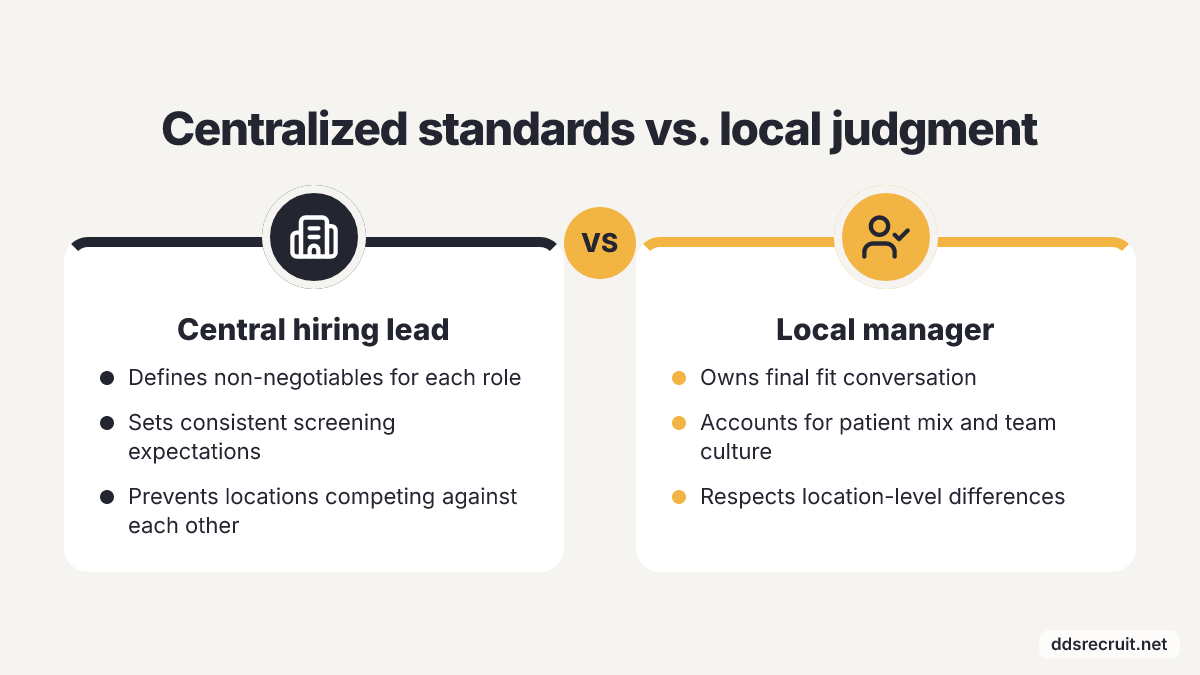
Multi-location pediatric practices need a shared hiring standard before they need more job ads. A DSO or group practice can fill seats faster when every location uses the same screening expectations for associate dentists, hygienists, assistants, and front office roles, but each office still needs room to account for its patient mix and team culture.
A multi-location practice in California searching for a dental staffing agency for multi-location practices should ask how candidates are matched across offices, not just whether coverage is available. California does not change the core hiring question: the recruiter or staffing partner must understand dental roles, schedule coverage, and whether a candidate who works well in one child-focused setting will fit another.
The Health Resources and Services Administration's National Center for Health Workforce Analysis reported in 2024 a shortage of 29,740 FTEs dental hygienists and a shortage of 11,860 FTEs general dentists. A group practice cannot solve that workforce shortage alone, but it can stop competing against itself with inconsistent postings, different interview standards, and delayed responses across locations.
A central hiring lead should define the non-negotiables for each role. For pediatric dentistry, those standards might include comfort with children, communication with parents, documentation habits, infection control expectations, schedule reliability, and willingness to work within the clinical systems used across the group.
Local managers should still own the final fit conversation. A candidate may meet the group's standard and still be a poor match for an office with a heavier sedation schedule, a different assistant model, or a front desk that handles a higher volume of parent communication.
A shared scorecard gives the group a way to compare candidates without flattening judgment. The scorecard should cover role requirements, pediatric communication, schedule compatibility, compensation alignment, and manager notes from the working interview or final conversation.
A staffing partner becomes more valuable as locations multiply because the cost of inconsistency grows. One office hiring quickly with weak screening and another office waiting too long both create turnover pressure, and a group practice needs a channel that keeps candidate quality steady while still respecting location-level fit.
What should the first week away from job boards look like?
The first week should produce a cleaner candidate path, not a new pile of tasks. A pediatric practice owner or office manager should decide which role is most urgent, choose the channel that matches the risk, and write a tighter role brief before sending anything into the market.
Start by naming the staffing problem in operational language. "We need a hygienist" is too broad, while "We need a hygienist who can handle a busy pediatric recall schedule and communicate well with parents" tells a recruiter, referrer, or passive candidate what kind of person belongs in the conversation.
Next, separate coverage from hiring. If the office needs chairs covered right away, pursue temporary or fill-in support while the permanent search runs in parallel, because an urgent schedule gap will distort every interview if the practice treats the next available candidate as the long-term answer.
Then, assign one person to manage response speed. A candidate who is contacted promptly, given clear next steps, and asked role-specific questions learns that the practice respects time, which matters in a tight dental labor market.
After that, test the role brief with someone who understands dental work. A dental-specific recruiter, a trusted hygienist, or a senior assistant can flag language that sounds attractive to an owner but vague to a candidate, especially when the role involves children, parent communication, or fast room turnover.
Finally, decide when to stop posting and start changing the offer. If a role gets attention but the right candidates decline, the practice should revisit pay, schedule, benefits, leadership expectations, or the realism of the job description before buying more visibility.
Conclusion
Begin with the vacancy that is hurting the schedule most. Then pick the channel that fits the main risk, whether that is coverage, a permanent hire, passive outreach, or consistency across locations. A pediatric dental practice does not need a louder job post until it has a sharper role brief and a faster screening path.
The next step is concrete. Write the role in clinical terms, ask the team member with the strongest local network for named referrals, and talk with a dental-specific recruiter if the opening needs screening beyond what an office manager can handle between patients. Job boards can stay in the background, but the first move should be a hiring channel that reaches qualified dental candidates before the practice loses another week to weak applications.
Frequently Asked Questions
What are the best alternatives to job boards for dental hiring?
The best alternatives include using dental-specific recruiters, leveraging referral pipelines from current staff, employing temp or fill-in staffing for immediate needs, and conducting direct outreach to passive candidates. These methods are more effective at targeting the right candidates, especially for child-focused practices.
Why might a dental job board not be effective for pediatric dental roles?
Dental job boards often reach only part of the available market, as the hardest pediatric dental hires are usually already employed or only interested if the practice matches their preferences. Job boards treat every applicant the same, which is not ideal for specialized roles that require specific skills and experience.
How can a dental practice effectively use a referral pipeline for hiring?
A referral pipeline is effective when it starts with a named role and specific criteria, such as experience with children and schedule preferences. The practice should identify employees with strong networks, provide a clear message about the role, and respond quickly to referrals to maintain a well-organized hiring process.
When is temp or fill-in staffing the best option for a dental practice?
Temp or fill-in staffing is the best option when the immediate risk is an open shift that needs coverage. It provides short-term support to protect production and patient experience while the practice continues a more deliberate search for a permanent hire.
What role does DDS Recruit play in dental hiring?
DDS Recruit is a dental-industry-specific recruiting firm that helps dental practices fill open roles with qualified, culture-fit candidates. They specialize in dental team recruitment, associate dentist placement, and dental hygienist and assistant staffing, providing focused support when job boards do not yield viable hires.
Where to go next
Related reading
Sources
- ADA News — Five years later: Staffing shortages, infection control since the COVID-19 pandemic (Feb. 2025)
- ADA News — New ADA policies empower states to alleviate dental workforce shortage (Nov. 2024)
- HRSA National Center for Health Workforce Analysis — Health Care Workforce, 2024 report (Nov. 2024)
- LinkedIn Talent Solutions — Active vs. Passive Candidates: The Latest Global Breakdown Revealed (Talent Trends 2014 report)